 | |
 |
 |
 |
 |

|
|
|
||||||
| ||||||||
 |
|
|
 We picked this dispatch as today's "Best." We picked this dispatch as today's "Best."Click here to have future picks e-mailed to you!
Garlic juice! / Spanish and salsa are ricocheting off the walls ... Beans are burning on the grill ...
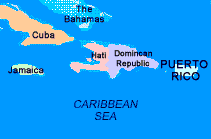
As you can imagine, this caused quite a rift in both nations. "Anti-imperialists" were furious that the United States was buying up lands without the consent of the people who actually lived in them. President McKinley and the majority of Congress, however, were "imperialists." According to them, the United States had an obligation to the "welfare of an alien people" - even if those "aliens" didn't want it.
Pros and Cons of U.S. Statehood
In 1917, President Woodrow Wilson passed the Jones Act, which made all Puerto Ricans citizens of the United States. This may sound like a generous gesture, but it came with a catch. Citizenship meant that Puerto Ricans had to serve in the military - and at that moment, the United States was engulfed in World War I. Puerto Ricans have been fighting on behalf of the United States ever since.
Things started looking up for the island in 1946, when President Truman finally appointed a governor who was actually native Puerto Rican. Since 1948, all Puerto Rican governors have been elected by the people of Puerto Rico. In 1952, the island became a commonwealth and remains so to this day. This leads us to the $10,000 question: Would Puerto Ricans prefer to be a full-fledged state, or would they rather remain a commonwealth?
These were the questions Stephen and I asked people as we roamed through the streets of Spanish Harlem, the neighborhood that runs from about 97th Street to 116th in upper Manhattan. Interestingly, we didn't meet a single person who supported statehood. That option would give all Puerto Ricans the right to vote in the presidential election (at present, only Puerto Ricans who live in the United States can vote), as well as representation in Congress (at the moment, they only have a non-voting resident commissioner).
"I definitely don't want statehood, because that would hurt my culture," he said. "We have already become assimilated enough as it is. I don't want to deal with people who are against things like bilingual education. I also don't want to have to pay federal taxes. I'd rather just not vote."
After visiting with Negron, Stephen and I stumbled upon an organization called Hermanos Fraternos de Loiza Aldea, which provides immigration services and ESOL classes to those in need. Its executive director, Blanca Irizarry, came to the United States after divorcing her husband nearly 37 years ago and has been here ever since. She would love to see her homeland fully independent, but doesn't think the United States would ever allow it.
"First of all, we're a play yard for American people," she said, referring to the island's luscious beaches. "But the main reason is that we're a very strategic military site."
Fighting for an Independent Identity
English-only laws and the United States' unwanted military presence are two major reasons why nationalist groups have demanded Puerto Rican independence throughout this century. The '50s were a particularly volatile time - in addition to attempting to assassinate President Truman, a group of Nationalists also opened fire in the chamber of the U.S. House of Representatives, wounding five.
"It is like you are a child and you need a parent to decide what is good for you," he said. "It affects the way you see yourself. I am convinced that this is the reason why Puerto Ricans have so many problems with mental diseases, alcoholism, and drug abuse.".
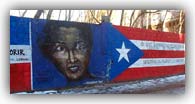
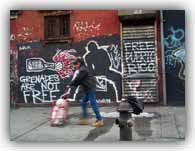
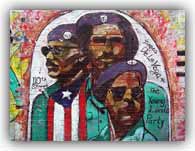
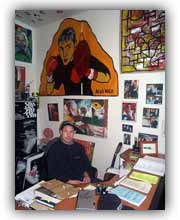
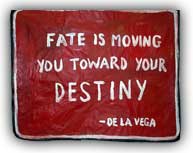
The most visible contributor, however, is a 28-year-old artist named James De La Vega. Over the past seven years, Spanish Harlem has become his personal canvas. He has painted murals of revolutionary heroes like the Puerto Rican freedom-fighting "Young Lords," as well as urban interpretations of "The Last Supper," the Crucifixion, and Picasso's "Guernica." His inspiring philosophies - such as "Fate is moving you toward your destiny" and "Enjoy the day as if it were your last" -- are scrawled in chalk along the sidewalk. We found him hard at work in his studio at 1651 Lexington Avenue near 104th Street.
De La Vega pointed at the throngs of Puerto Rican neighbors and families bustling about outside and said, "One of my main ideas is to get people to become their dream."
Stephen and I left Spanish Harlem feeling the same way.
Stephanie
Please email me at:
stephanie@ustrek.org
Jen - The first U.S. president … of Nicaragua |